Arm yourself with knowledge that allows you to take a proactive approach.
Here are some resources that can help you to better understand your lung cancer.

LUNG CANCER PATIENT
CONVERSATION GUIDE
This brochure includes key terminology and information that you need to know to help facilitate conversation between you and your doctor.
Download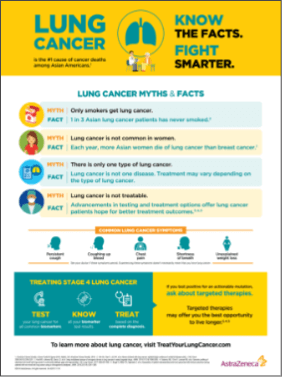
LUNG CANCER
EDUCATIONAL POSTER
This poster highlights the important facts about lung cancer, including common misconceptions, early warning signs, and the steps your doctor may take to treat your stage 4 lung cancer.
DownloadUNDERSTANDING BIOMARKERS IN YOUR LUNG CANCER
DETECTIVE BIO:
Hello! I am detective Bio.
Today, let’s find important clues to help guide your lung cancer treatment.
TEXT ON SCREEN:
UNDERSTANDING LUNG CANCER TREATMENT
DETECTIVE BIO:
A key clue to solving your case is a biomarker.
Then, what is a biomarker?
TEXT ON SCREEN:
Know your biomarker status
What is a biomarker?
DETECTIVE BIO:
Every person has a different fingerprint.
Just as each fingerprint has a different pattern, each person's lung cancer may have a different signature.
These signatures are called biomarkers.
TEXT ON SCREEN:
Biomarkers
Biomarkers reveal different traits of each individual's lung cancer.
DETECTIVE BIO:
Certain lung cancer biomarkers may help doctors to better understand a patient’s specific type of cancer and to better determine their appropriate treatment options.
TEXT ON SCREEN:
Treatment Options
Surgery | Targeted Therapy | Immunotherapy | Chemotherapy | Radiation
Treatment options will depend on your type and stage of lung cancer. Talk to your doctor about which treatment options may be right for you.
DETECTIVE BIO:
Biomarkers sometimes emerge from mutations in DNA.
TEXT ON SCREEN:
Normal Cells
Cancer Cells
EGFR* mutation detected
*EGFR = Epidermal Growth Factor Receptor
DETECTIVE BIO:
Genetic mutations in the epidermal growth factor receptor, or EGFR gene -- among various biomarkers -- can drive your lung cancer to grow and spread.
EGFR mutations are a type of biomarkers that are common in patients with lung cancer from Asia.
Approximately 45% of Asian non-small cell lung cancer patients test positive for an EGFR biomarker.
TEXT ON SCREEN:
Asian Lung Cancer Patients
Approximately 45% of Asian non-small cell lung cancer patients have an EGFR biomarker.*
*Percentages are for the most common type of NSCLC called adenocarcinoma.
DETECTIVE BIO:
If an EGFR biomarker is found in your lung cancer through biomarker testing, you and your doctor may discuss a treatment plan that specifically targets it.
TEXT ON SCREEN:
Blood Test*
Tissue Test
*Used to determine biomarkers in stage 4 lung cancer.
Biomarker testing can help your doctor determine your treatment options.
DETECTIVE BIO:
That’s why biomarker testing is a key step in your complete diagnosis.
If you are diagnosed with lung cancer, make sure to ask your doctor about biomarker testing. It’s okay to ask.
TEXT ON SCREEN:
Ask your doctor about biomarker testing
It’s okay to ask.
DETECTIVE BIO:
For more information, visit TreatYourLungCancer.com
TEXT ON SCREEN:
For more information, visit TreatYourLungCancer.com
©2021 AstraZeneca. All rights reserved. US-52720 Last Updated 11/21